Showing posts with label Energy. Show all posts

Wednesday, March 23, 2016

African Lights: Microgrids Are Bringing Power to Rural Kenya


Plugging into electricity for the first time is a big deal. Ask Peter Okoth. Until late last year, he struggled to make a go of his bar on the main street in Entasopia, a small, dusty town in Kenya’s Rift Valley, five hours from the capital Nairobi and 30 miles from the nearest grid power line. Then, he hooked up to a new solar-powered microgrid that serves local homes and businesses. 

Now Okoth has eleven light bulbs, he says proudly — and enough power to run a TV and a sound system for his customers. Seventy people show up some evenings to watch, listen and buy his food and drink. His profits will  
Soon buy a refrigerator to  keep the beer cold in the searing desert heat, and a big screen to show satellite sports channels. “We will be staying open till midnight,” he says. And he has just bought construction materials for ten guest rooms. “When you next come, you must stay here.” Most settlements in rural Kenya are dark at night. Only a third of the East African country’s residents have access to the national power grid. Harvesting the sun makes obvious sense in places like Entasopia. Hundred-dollar photovoltaic (PV) panels for installation on home roofs have been on sale for years. But the meager five watts that most such systems provide is only enough to power a couple of LED lamps each evening and a mobile phone charging point, and the batteries constantly need replacing. The country is full of discarded PV cells, defunct batteries, and disappointed customers. 

But now, larger central village PV units linked by underground cable to dozens of houses and business are starting to transform lives. For a ten-dollar installation fee, the people of Entasopia can connect to a village microgrid and buy a share of a thousand times as much power. Village homes are filling with household appliances like refrigerators and washing machines, and the businesses on the main street are powering everything from welding equipment and fuel pumps to hair driers. 

Microgrids are small electricity generation and distribution systems that operate independently of larger grids. Typically they rely on local sources of renewable energy, such as river flows, wind, biomass, or, most widely, the power of the sun. There are no official statistics on how many there are, or what their total power output is. But a recent study by U.S.-based Navigant Research, which studies new energy technologies, suggested that their combined generating capacity might now exceed 750 megawatts worldwide. They are, says Daniel Kammen, of the University of California,Berkeley, “a true hot-bed of innovation popping up all over the world.”

Energy Landscapes: An Aerial View Of Europe’s Carbon Footprint

PHOTOS BY ALEX MACLEAN

Europe and the United States have very similar standards of living, but significantly different carbon footprints — with Europe’s per capita carbon emissions less than 50 percent of those in the U.S. Aerial photographer Alex MacLean decided to document this phenomenon in an attempt to understand how the highly developed nations of northern Europe are able to spew significantly less carbon into the atmosphere. Flying over Sweden, Denmark, Germany, the Netherlands, and Wales with camera in hand, MacLean came away with an appreciation for how a country’s carbon footprint is directly related to how efficiently it designs, moves through, and powers its built environment.

Over a series of months, MacLean documented historical design advantages that many European nations have inherited and now knowingly reinforce in their physical landscapes: dense urban centers with an emphasis on pedestrian and bike accessibility; compact rural and suburban communities with sharp growth boundaries; connectivity between public transport and human-powered transportation; the integration of commercial and retail space into the fabric of residential areas; and a dearth of sprawl. “How we organize ourselves on the ground is the key factor determining how much fossil fuel we burn,” MacLean says.

Monday, March 21, 2016

Energy: Five Good Questions

“Almost every way we make electricity today, except for the emerging renewables and nuclear, puts out CO2. And so, what we’re going to have to do at a global scale, is create a new system. And so, we need energy miracles.” –Bill Gates

Energy is one of the most important topics facing our modern, industrialized civilization. What sources we get it from, what we use it for, and how we deal with the waste from its production are paramount to the future of our species on Earth.


Yet in many ways, energy is one of the most poorly understood quantities in all of physics. To help you better understand it, let’s take a look at five good questions about energy. Starting with…


1.) What is energy? Anyone who’s ever taught or taken a course in introductory physics has likely encountered this question. Most physicists, perhaps unfortunately, define energy as the ability to do work. And so you go and ask what work is, and you get the circular definition that it’s the transfer of energy from one source to another.
Maddening.

It’s not like wikipedia does any better, mind you. But just because we don’t have a good definition of it doesn’t mean we can’t quantify, test, and indirectly measure it.

Don’t feel bad; no less a physicist than Newton had no concept of energy. And yet unlike Newton, I bet that you know it when you see it. Some things we do know about energy are:

we know that all mass and matter contains it,
we know how to quantify it,
we know how much is stored electrically, chemically, thermally, sonically, etc.,
we know how to convert it from one form to another,
we know how to use it to accomplish things (i.e., to do work),
we think it can never be created nor destroyed,
and we can generate, calculate, and measure its various forms.
So let’s take on a more useful question than asking for a simple dictionary definition:

2.) What can we do with energy? Well, we already said, “work,” but that has a specific meaning to a physicist. If you “push” something, or otherwise apply a force to it, while it simultaneously moves in that direction, congratulations! That’s what work is!

Whether you’re lifting a weight up, pedaling a bicycle, driving a car, or spinning a turbine, work is being done. And that’s what energy can do.
More than that, of course, is that you don’t need to do it. Anything that lifts a weight, pedals a bike, drives a car, or spins a turbine can do work, and therefore, has energy. Atomic nuclei, molecular bonds, gravitation, relative motion of massive bodies and electromagnetism are all possible physical sources of energy, as nuclear power, fossil fuels, hydroelectric dams, wind power and solar power are respective examples of each.


3.) How much energy do we use? If you’re reading this, you’re probably in a location that has seemingly endless, cheap access to at least one of these forms of energy. Well, all total, humans use a lot of energy. In practice, it’s much easier to measure power, or the rate at which we use energy. So take that power and multiply it by a certain amount of time, and you’ll find out how much energy we use.
How much power do we use?

4.) What’s the “holy grail” of energy? Well, you have to be careful here. Some people dream about taking all the ambient thermal energy around us and using it to meet our energy needs.


5.) What does the future hold for nuclear fusion? Well, we definitely don’t want to do it the same way the Sun does it. But we still want to start with our cheap, light, easy fuel and get that nuclear energy out of it. And we’ve got three ways we know of to make it happen, each one getting closer to the magical (metaphorically) breakeven point. What are th

Source by: http://scienceblogs.com/startswithabang/2011/07/20/energy-five-good-questions/

Renewable Energy


Our vision is an energy system that relies heavily on renewable sources of electricity and fuels to meet our needs for electricity, heating, cooling and transportation. GPI’s current efforts to promote clean sources of electricity are described above under our “energy infrastructure” section. Areas of focus on renewable fuels include:

Growing the nation’s renewable biogas and biomethane industry.
Turning abundant organic “wastes” into renewable energy.
Supporting the commercialization and scale-up of next-gen biofuels (from non-food sources).
Promoting bioproducts and chemicals as a growth strategy for modern biorefineries.

Source by: http://www.betterenergy.org/programs/renewable-energy

Wednesday, March 16, 2016

The War of the Currents: AC vs. DC Power

Electrical transmission lines cross a snow-covered field in Dallas Dam, Oregon. | Photo courtesy of the Energy Department


It’s #GridWeek on Energy.gov. We’re highlighting our efforts to maintain a reliable, resilient and secure electric grid across the country, and what that means for you. We’ll be hosting a Twitter chat on How the Grid Works on Thursday November 20 at 2 PM EDT. Send us your questions on Twitter, Facebook and Google+ using #GridWeek.

Starting in the late 1880s, Thomas Edison and Nikola Tesla were embroiled in a battle now known as the War of the Currents.

Edison developed direct current -- current that runs continually in a single direction, like in a battery or a fuel cell. During the early years of electricity, direct current (shorthanded as DC) was the standard in the U.S.

But there was one problem. Direct current is not easily converted to higher or lower voltages.

Tesla believed that alternating current (or AC) was the solution to this problem. Alternating current reverses direction a certain number of times per second -- 60 in the U.S. -- and can be converted to different voltages relatively easily using a transformer.

Edison, not wanting to lose the royalties he was earning from his direct current patents, began a campaign to discredit alternating current. He spread misinformation saying that alternating current was more dangerous, even going so far as to publicly electrocute stray animals using alternating current to prove his point.

The Chicago World’s Fair -- also known as the World’s Columbian Exposition -- took place in 1893, at the height of the Current War.

General Electric bid to electrify the fair using Edison’s direct current for $554,000, but lost to George Westinghouse, who said he could power the fair for only $399,000 using Tesla’s alternating current.

That same year, the Niagara Falls Power Company decided to award Westinghouse -- who had licensed Tesla’s polyphase AC induction motor patent -- the contract to generate power from Niagara Falls. Although some doubted that the falls could power all of Buffalo, New York, Tesla was convinced it could power not only Buffalo, but also the entire Eastern United States.

On Nov. 16, 1896, Buffalo was lit up by the alternating current from Niagara Falls. By this time General Electric had decided to jump on the alternating current train, too.

It would appear that alternating current had all but obliterated direct current, but in recent years direct current has seen a bit of a renaissance.

Today our electricity is still predominantly powered by alternating current, but computers, LEDs, solar cells and electric vehicles all run on DC power. And methods are now available for converting direct current to higher and lower voltages. Since direct current is more stable, companies are finding ways of using high voltage direct current (HVDC) to transport electricity long distances with less electricity loss.

So it appears the War of the Currents may not be over yet. But instead of continuing in a heated AC vs. DC battle, it looks like the two currents will end up working parallel to each other in a sort of hybrid armistice.

And none of that would be possible without the genius of both Tesla and Edison.

Source by:http://energy.gov/articles/war-currents-ac-vs-dc-power

The Year of Concentrating Solar Power: Five New Plants to Power America with Clean Energy

The Ivanpah Solar Electric Generating System in Ivanpah Dry Lake, California. | Photo by Gilles Mingasson, Getty Images for Bechtel.


Solar is increasingly providing clean, sustainable energy for our nation’s homes, businesses and industries. Clocking record-breaking growth and reaching a total of more than 4,700 megawatts of new installed capacity, 2013 was a big year for solar photovoltaic systems. But we’re also excited to watch 2014, which will mark a major milestone for a different form of solar energy: concentrating solar power (CSP).

CSP technology uses mirrors to focus and concentrate sunlight onto a receiver from which a heat transfer fluid carries the thermal energy to a power block to generate electricity. The technology can generate energy even when the sun isn’t shining, helping to provide clean power at times of peak demand. 

We recently rolled out the Energy Department’s new report, 2014: The Year of Concentrating Solar Power, which focuses on five of the most innovative CSP plants in the world. All of these projects are expected to be switched on in the southwestern United States by the end of the year as a result of sustained, long-term investments by the Department and committed solar industry partners.

These five new utility-scale CSP plants will pay major dividends. When completed, they will have the capacity to generate 1.26 gigawatts of electricity, nearly quadrupling America’s preexisting CSP capacity with the potential to power more than 350,000 average American homes.

These innovative CSP plants illustrate how the Energy Department advances high-impact clean energy technologies from inception to market through sustained, long-term investments. First, Energy Department research and development programs -- like the SunShot Initiative -- advance early-stage technologies. In this case, CSP technology was initially developed with the support of the Energy Department's Office of Energy Efficiency and Renewable Energy. Then, our Loan Programs Office worked with the private sector to encourage investment and accelerated deployment of CSP technology at commercial scale.

Loan guarantees are an instrumental way the Energy Department helps technologies like CSP get the financing they historically have trouble accessing for their first few commercial projects. Through successful public-private partnerships, we’ve been able to prove that CSP is a commercially viable energy source in the U.S., and we look forward to seeing it grow in the future.

Source by:http://energy.gov/articles/year-concentrating-solar-power-five-new-plants-power-america-clean-energy

Top 6 Things You Didn't Know About Solar Energy

Installing a concentrating solar power system in Gila Bend, Arizona. The curved mirrors are tilted toward the sun, focusing sunlight on tubes that run the length of the mirrors. The reflected sunlight heats a fluid flowing through the tubes. The hot fluid then is used to boil water in a conventional steam-turbine generator to produce electricity. | Photo by Dennis Schroeder.


This article is part of the Energy.gov series highlighting the "Top Things You Didn't Know About..." series. Be sure to check back for more entries soon.

6. Solar energy is the most abundant energy resource on earth – 173,000 terawatts of solar energy strikes the Earth continuously. That's more than 10,000 times the world's total energy use.

5. The first silicon solar cell, the precursor of all solar-powered devices, was built by Bell Laboratories in 1954. On page one of its April 26, 1954 issue, The New York Times proclaimed the milestone, “the beginning of a new era, leading eventually to the realization of one of mankind’s most cherished dreams -- the harnessing of the almost limitless energy of the sun for the uses of civilization.”

4. The space industry was an early adopter of solar technology. In the 1960s the space industry began to use solar technology to provide power aboard spacecrafts. The Vanguard 1 -- the first artificial earth satellite powered by solar cells -- remains the oldest manmade satellite in orbit – logging more than 6 billion miles.

3. Fast track to today and demand for solar in the United States is at an all time high. In the first quarter of 2012, developers installed 85 percent more solar panels compared to the first quarter of last year. Total U.S. installations may reach 3,300 megawatts this year – putting the country on track to be the fourth largest solar market in the world.

2. As prices continue to fall, solar energy is increasingly becoming an economical energy choice for American homeowners and businesses. Still, the biggest hurdle to affordable solar energy remains the soft costs – like permitting, zoning, and hooking a solar system up to the power gird. On average local permitting and inspection processes add more than $2,500 to the total cost of a solar energy system. The Energy Department SunShot Initiative works to aggressively drive down these soft costs – making it faster and cheaper for families and businesses to go solar.

1. In California’s Mojave Desert, the largest solar energy project in the world is currently under construction. The project relies on a technology known as solar thermal energy. Once the project is complete 350,000 mirrors will reflect light onto boilers. When the water boils, the steam turns a turbine, creating electricity. The project is expected to provide clean, renewable energy for 140,000 homes and is supported by an Energy Department loan guarantee. More details on the Energy Department’s investments in large scale, innovative renewable energy projects in this slideshow.


Top 6 Things You Didn't Know About Nuclear Power

These are the first lightbulbs lit by nuclear fission at Argonne's EBR or Experimental Breeder Reactor.| Energy Department photo.


This article is part of the Energy.gov series highlighting the “Top Things You Didn’t Know About…” Be sure to check back for more entries soon.

Historically, some key advancements in nuclear energy happened during the month of December. On December 2, 1942, Enrico Fermi created the first self-sustaining nuclear reaction at Stagg Field in Chicago. Eight years later, on December 20, 1951, the first nuclear electricity was produced at an Argonne facility in Idaho -- now the Idaho National Lab.

Here are some other facts you might not know about nuclear energy.

Nuclear power is one of the two ways to produce electricity for multi-year space missions. The other is solar power. Check out the history of nuclear power in space to learn more.

Small Modular Reactors -- or SMRs -- are one of the latest nuclear innovations. Check out our handy SMR infographic on how they’re designed, how they work and why they’re important.

The Energy Department offers scholarships and fellowships for undergraduate and graduate research in nuclear science. In May we awarded over $5 million for 42 undergraduate scholarships and 33 graduate fellowships. Learn more about these programs on the Nuclear Energy University Programs website.
The world’s first full-scale nuclear power plant was opened December 23, 1957 in Shippingport, PA. This is six years -- almost to the day -- after the first nuclear electricity was produced at an Argonne lab site in Idaho.
Illinois is by far the largest producer of nuclear energy in the United States, followed by Pennsylvania and South Carolina. Illinois produced 1,010.2 trillion British Thermal Units or BTU in 2012. Pennsylvania produced 787.8 trillion BTU and South Carolina produced 536 trillion BTU. You can find more information on our map of energy production by state.
The Department of Energy has a middle school curriculum that centers on nuclear energy available on our website. It’s called The Harnessed Atom.
To learn more about nuclear energy and the Energy Department’s research, check out our nuclear energy page.

Tuesday, March 15, 2016

People love renewable energy, so why don't politicians get it?

 Surveys consistently show that British people like renewable energy and community projects even more. Photograph: Richard Osbourne/Blue Pearl Photographic/Alamy


obin Hood: one of Britain’s best-loved folk heroes. He speaks to our national love of subverting the rules. Fighting against institutional injustice, he protected the most vulnerable from the predatory practices of a corrupt establishment.

Nottingham city council’s new not-for-profit energy supply company, Robin Hood Energy, is not only the first of its kind, but the perfect contemporary manifestation of this spirit of righteous derring-do.Aware that the most vulnerable households – those on prepayment meters – were getting the worst deal from our current set up of the big six energy suppliers, and frustrated with the agonisingly slow progress from the government, Nottingham city council decided to take matters into its own hands and become a fully licensed energy supplier.

This bold plan had three aims: tackle local fuel poverty, return profits to customers via reduced tariffs and support community energy projects to get local renewable generation off the ground.

As Nottingham’s project lead Gail Scholes told me in May, navigating the onerous and painful regulation minefield this entailed was not for the faint-hearted. The UK’s energy market rules are sclerotic and abstruse, designed and written by their incumbent beneficiaries, the big six, in a way that seems calculated to freeze out new competitors.But Nottingham bravely battled through and a little over two years later has, rather serendipitously, finally launched Robin Hood Energy at the start of Britain’s annual Community Energy Fortnight.

Nottingham’s project is just a part of a fast-growing national movement to take back power – both literally and figuratively – for the people. From Cornwall to the Highlands, the past five years have seen local community renewable energy schemes mushrooming. Many of them are opening their doors over Community Energy Fortnight, when the public will be able to see community solar in action at Palmers Green Mosque in London, community hydro at Osney Lock in Oxfordshire and community wind at Marshill Farm in Lanarkshire, Scotland.

Surveys of public attitudes to different energy sources consistently show that British people like renewable energy a lot and want to see more of it. But throw community ownership into the mix and like turns to love – a recent Co-Op Energy poll showed that even Conservative voters would overwhelmingly support a local wind farm if it was owned and controlled by the community. Nearly four-fifths of those surveyed want the government to do more to help communities generate their own power and keep the profits.

Unfortunately, the government seems to have little interest in what the public wants from the UK’s energy system, pushing ahead with fracking in the teeth of intense and growing public hostility while launching a savage surprise attack on the nation’s favourite source of renewable energy, solar power.

The story of Balcombe in West Sussex perhaps best embodies the mismatch between public preferences and current energy policy. Two years after Cuadrilla packed up and left following huge protests against its plans to frack there, the residents of Balcombe are on the cusp of realising their mission to generate enough locally owned solar energy to meet the electricity needs of every home in the village.

Later this month, if all goes according to plan, the people of Balcombe will gain planning permission for a 5MW solar farm and begin a scramble to raise the £5m necessary to get the facility built before next April – when solar farm support will come to an abrupt end.

If the government goes through with its plans, there will be no new community solar farms after Balcombe’s, no more community wind or hydro schemes and one million fewer solar roofs installed nationwide over the next five years. There will be an awful lot of fracking going on though.

Source by:http://www.theguardian.com/public-leaders-network/2015/sep/10/renewable-energy-politicians-community-fracking

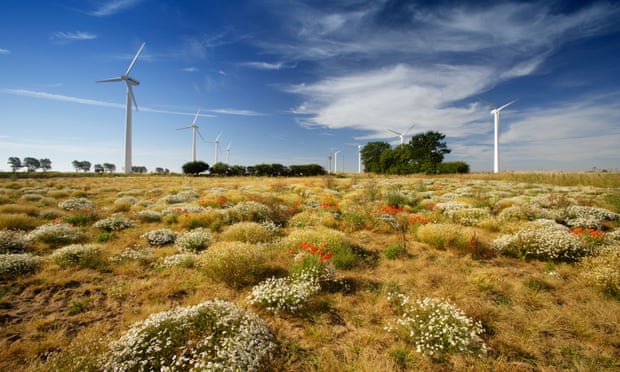
Wind power most popular source of energy in UK

Half of respondents to national survey would welcome a new wind farm within five miles of their home

 The study, which was across incomes and political allegiances, found that windfarms would be the most welcomed form of power source. Photograph: Murdo Macleod


Wind power is the most popular source of energy in the UK, according to an exclusive survey of attitudes towards the energy market carried out on behalf of the Guardian.

A study of more than 2,000 people across incomes and political allegiances found that windfarms would be the most welcomed form of power source, as plans are made to develop new energy capacity in the UK. Almost half of respondents (48%) said an onshore windfarm would receive positive reception if it was developed within five miles of their home.

By contrast, only a fifth could say the same for a new coal powered station, and just 27% said a new nuclear power station would be welcomed in their area. Fracking garnered the least support: 19% of respondents said development of this new technology would receive a positive local reception.

Support for wind power was high among supporters of all parties, though enthusiasm for onshore wind was lowest among those who identified themselves as Conservative (39%, compared with 56% among Labour voters and 45% for those who said they were aligned with Ukip).

The survey results come as government data revealed there had been a sharp rise in the percentage of onshore windfarm applications being rejected. Rejections across the UK jumped from 25-29% in 2009-12 to 41% in 2013. Communities secretary Eric Pickles has told planners to give greater weight to local concerns over windfarm applications, claiming "current planning decisions on onshore wind are not always reflecting a locally-led planning system".

The Conservative party has pledged to drop subsidies for new onshore wind turbines if elected with an overall majority in 2015. And despite evidence that support is generally widespread, Pickles has taken 35 wind power planning appeals out of the hands of the planning inspectorate since last June, refusing eight and approving two so far, and opening his party up to criticism of "heavy-handed intervention".

The Guardian study, carried out by Harris Interactive during April 2014, revealed that support was even higher for offshore wind, with more than half (55%) saying they believed it would be welcomed (though all respondents were open to answer this question, regardless of their location).Despite a bitter debate between central and local government politicians, 40% of voters say they "neither support nor oppose" fracking for shale gas in the UK. Just 8% say they "very much support" the policy, compared with the 18% who "very much oppose" it.

Only a third (32%) said energy prices had an influence on their voting intentions, despite the fact that the majority (81%) said they were concerned about the rise in the cost of energy. This ranked highest among concerns about the energy market, above cutting carbon emissions (52%) and the possibility of power cuts (51%).

Despite being among the cheapest in Europe, 71% said they perceived UK energy prices as unreasonable. Two-thirds of respondents believed that UK prices were higher than the global averages, and higher than other EU countries. Due to fears about rising prices, two-thirds said they were willing to consume less electricity during peak times.

This article is part of the Guardian's #bigenergydebate series. Click here to find out more about this project and our partners.